ASCENSION OF THE LORD Theme: It is our duty to go out and evangelize
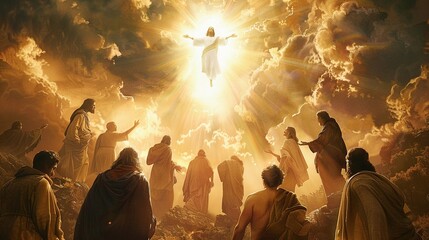
The forty days that preceded the Ascension were days of preparation for the young Church. Like Moses, Elijah, Jesus and the members were equipped for their mission of being witnesses to the ends of the earth. Jesus’ departure anticipated his return. He was lifted up, and a cloud took Him out of their sight. Formless in nature prior to all creations, God could not have had a physical body since the physical world did not exist as of yet; nor could He have had a spiritual body since the spiritual world had not been created as of yet. So how could God manifest Himself to the physical world after creation? It was by His Incarnation through Jesus Christ. What we celebrate on Ascension Day is the human departure of Jesus from this world. Jesus wants the disciple to be missionary, to disengage themselves from the known to the unknown, meaning to move from Jerusalem to Galilee. The disciples had to start proclaiming the gospel from the very place where he had stated his public life. Galilee was a region rather looked down upon by the rest of Israel because it was composed of a population that hard mixture of various races including non-believes. Due spiritual and political compromises, Jerusalem had lost the privilege of being a spiritual agenda. The Church started by Jesus Christ, with the support of the Holy Spirit through the Father was to continue the ministry of salvation. Even today, 2,000 years later, we can say that we are the ascension Church that is ready to go and transform the world. Today we are being commissioned to continue our ministry of saving souls to the ends of the world.
First Reading: Acts 1: 1-11
The First Reading from the Acts of the Apostles Acts 1:1-11 began by introducing us to the first Book of the New Testament. In the first verse, we heard that Luke had written another book which is the Gospel according to Luke. Biblical history tells us that originally, the two books, the Gospel according to Luke and the Acts of the Apostles, were joined together at Luke 24:49 and Acts 1:6. When the Catholic Church arranged the New Testament Canon books, the volume of Luke was divided in two books, in the manner in which we presently enjoy them.
Jesus ordered His disciples not to leave Jerusalem until such time as they had received the promise. What was this promise? It was the gift of receiving the Holy Spirit. This promise is still manifested today through the Sacrament of Confirmation. Why were the disciples commanded to stay in Jerusalem? It is because Jerusalem was chosen by God as the City in which the spiritual Kingdom was to be established. Parallel to the Catholic Church, the visible Body of Christ, having its seat at the Vatican, the invisible Body of Christ has its seat in Jerusalem. The reception of the Holy Spirit was very important because He had been chosen and sent by the Father and the Son to sustain Christianity in a new era of sacred history, the era of the Church and its mission. From Jerusalem, the geographical center of sacred history was to begin the apostolic mission of the apostles who had been prepared by Jesus in the three years prior to His Ascension into heaven. Luke writes this message to affirm that Ascension Day is an experience of faith which is so important for the first Christian Community to the extent of giving it a new name Theophilus meaning the one who loves God.
It was in the mind of believers that all the people who do God’s will, would be assumed into Heaven body, mind and soul. This was the case with Enoch, Elisha and Elija. The risen Lord hard conquered the rules and forces of nature. As he was above, then he would be present for all who call upon his name. The figure forty is a biblical symbol that stands for a period of waiting. Even in our time, those who have not encountered the Lord in Sacraments are in a period of waiting. In the case of Ascension, the disciples who had run away during the Passion Week had to return to the Sinai desert and re-qualify their commitment to the risen Lord. Luke is saying that it is after these forty days that the disciples can stand qualified as authentic disciples of Jesus.
The memorable gift of the Holy Spirit was to accompany them every where even in the most difficult places. For a good this like the Kingdom, the Apostles wanted everything accomplished immediately so that Jesus can return and take them to his place; but Jesus removes this illusion by stating that the Kingdom of God in this world will not be a rapid and easy task. Salvation has already begun and will be successful, but the growth of the Kingdom will be slow like development of a seed.
The followers of the risen and Ascended Lord is supposed to be optimistic, to look down on earth and transform the world that is why task assigned to them is “You will be my witnesses” Acts 1:8. Christian faith is a stimulus to assist believers commit themselves seriously and concretely in transforming conditions of humanity. Issues of slavery, oppression, war, poverty, bad governance which are still part of our society have to give way to reconciliation, justice and peace. Through all the baptized, the risen Lord Jesus wants a transformed society. We need to take concrete steps and cause this fundamental transformation become a reality.
Second Reading: Ephesians 1: 17-23
Paul prays that God grants wisdom to his Christians to understand the mystery of the Church so that their senses may be opened to this great hope. A Christian should not overlook practical concrete responsibilities which are a duty in daily life. We are pilgrims awaiting Christ’s return as responsible citizens. St. Paul say, “I pray that the God of our Lord Jesus Christ, the Father of glory, may give you a spirit of wisdom and revelation as you come to know Him, so that, with the eyes of your heart enlightened, you may know what is the hope to which He has called you, what are the riches of His glorious inheritance among the saints and what is the immeasurable greatness of his power for us who believe, according to the working of His great power” Ephesians 1:17-19. St. Paul prayed that we may enjoy a spirit of wisdom and revelation so we may enjoy knowledge of the Heavenly Father, not only of His Plan, but of knowing God as He knows Himself. This is meant to assist us experience the great love of God. Such a love is tangible when we manifest it through our love for each other in true Christian behaviour.
Christian love has such as immeasurable power that is able to unite where once there was division. Such a love is able to heal where pain once existed. It forgives where condemnation once thrived. Christian love is not bound by gender, age, race, nationality or one’s social class. It has no barriers whatsoever. Out of this wonderful love God made Jesus the Head over the Church, which is His Body. Jesus is the invisible anointed Leader and Head of the visible Catholic Church that He has established on earth. He is the Leader of the past, present and future saints who belong to the invisible mystical Body that enjoys its seat in Jerusalem.
Gospel Mathew: 28:16-20
Matthew places the Ascension of top of the hill mainly to remind us of the presence of God. Transfiguration takes place on Tabor hill. Moses and Elija encounter on the hill top. The sending of the disciples into the whole world is an extremely important event thus it has to happen on the top of a hill. As it is with us even now ‘some of his disciples well still hesitant’ this is a proof that the Christian Community is not made up of perfect people, but a mixture of good and evil. Like the weed and the wheat in Matthew 13:29 and the good fish and the bad fish in Matthew 22:10. Every Christian Community is made up of people who have faith but who still are able to doubt. Yes in fact, we cannot have faith together with certainty. Like the disciples we can have a deep conviction of the truth of the resurrection of Jesus Christ but we can not verify the fact casually. The doubt of the apostles is a consolation for us. We believe in Christ, true, but we also at times feel doubts and uncertainties. This reality should not discourage us, Jesus has come to transform and strengthen our faith.
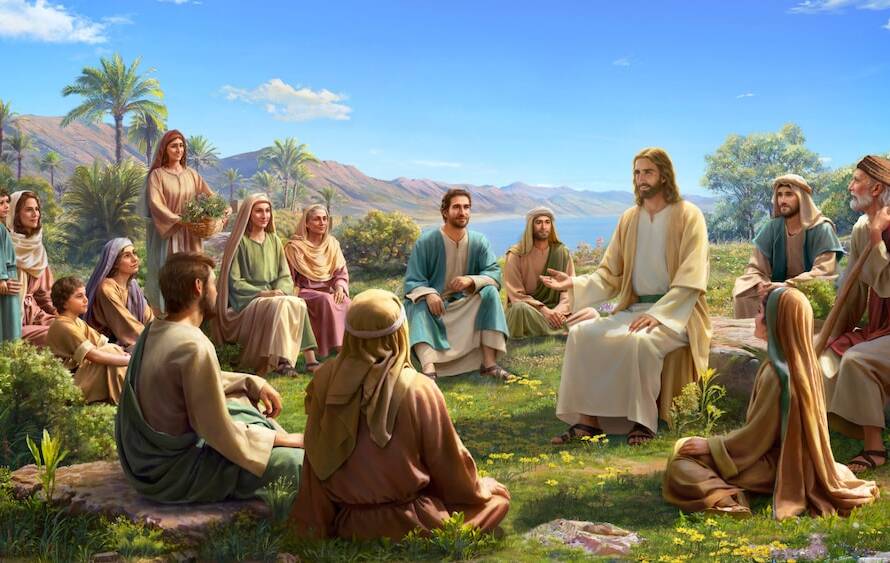
The second part of today’s gospel is about the Mission of the apostles to evangelize the whole world. First of all Jesus speaks with authority. He was sent by the Father to bring the message of salvation to the whole world. He now entrusts this proclamation to his disciples. They will have to bring the good news to the whole humankind, and in order to do this, they are given Jesus’ own powers. The Church has to make Christ present in the world. The new disciples will become members of the community by baptism. Through this Sacrament they will become sons and daughters of God and will share the life of the Trinity. Notice here that Jesus did not command the apostles to baptize in the ‘names’ but rather in the ‘name of the Father, the Son and the Holy Spirit’. While referring to the three Divine Presences of the Holy Trinity, He used the word ‘name’ in singular form.
Some may ask, ‘Why is this?’ When reviewing the Gospel of John, Chapter 17 as Jesus was praying for His disciples, He said, “Holy Father, protect them in your name that you have given me, so that they may be one as we are one” John. 17:11. ‘protected them in your name that you have given me’. Notice here that Jesus states that He and the Father shared the same Name. And what was that Name? It was the Name of Jesus. Therefore, based on the aforementioned, it can logically be understood that the Name Jesus also belonged to the Father.
Let us look at this from a different perspective. When St. Francis was blessed with the gift of bilocation, what was the name of his second presence? Was it not also ‘Francis?’ Certainly! Both were Francis. Why? Because they were one and same being manifested in two presences. Similar to this, the Most Holy of all names, the Name of Jesus, belongs to the Father, the Son, and the Holy Spirit. Therefore, in the Sacrament of Baptism, it is appropriate to invoke all Three’s Divine Presences, the Blessed Trinity in the one Name. The Gospel of Mathew ends with these very beautiful and encouraging words of Jesus ‘I am with you always; yes, to the end of time’. This means that ASCENSION is DESCENTION in the company of his disciples towards the human city.
This is the reason of our joy and of today’s feast; Jesus has not gone far from us, he has not gone to some other place. He is still with us in a different way. Before Easter he could only be in one place at a time, he could only speak to a number of people at the same time. Now all these limits have been removed. He is the glory of his Father, but still close to us forever and everywhere. After Easter, the Church now gown up, has to avoid ineffective regrets and longings and start on the job of proper evangelization. Through death on the Cross, followed by His glorious resurrection, Christ conquered those governing bodies. Now, none of them possess any power over Him. None of them can stand in the way of God’s progressive Divine Plan of salvation for mankind in the present age; for grace and mercy have been fulfilled through Jesus Christ.
Application
Having dominion over all creations, Jesus commanded His apostles, “go and make disciples of all nations, baptizing them in the name of the Father and of the Son and of the Holy Spirit, and teaching them to obey everything that I have commanded you. And remember, I am with you always, to the end of the age.” Matthew 28:19-20. Everything about the life of Jesus Christ is a blessing for us. After His resurrection the Lord blessed the Apostles with His presence, gloriously risen. When His earthly work with them was completed, He very explicitly blessed them. He led them out as far as Bethany, and lifting up his hands he blessed them. While He blessed them, he parted from them and was carried up into heaven. Even the Lord’s departure from us is a blessing as it empowers us to go proclaim the good news. It is our duty to be a blessing to one another wherever we find ourselves. Ascension gives each one of us a mandate to go and be evangelizers to all creation.
Fr Paulino Mondo